Prove your leadership programme works.
Masaar runs the psychometric assessment inside your programme, in Arabic and English. Every participant gets a development plan mapped to the modules they are about to take, and you can measure them again at the end.
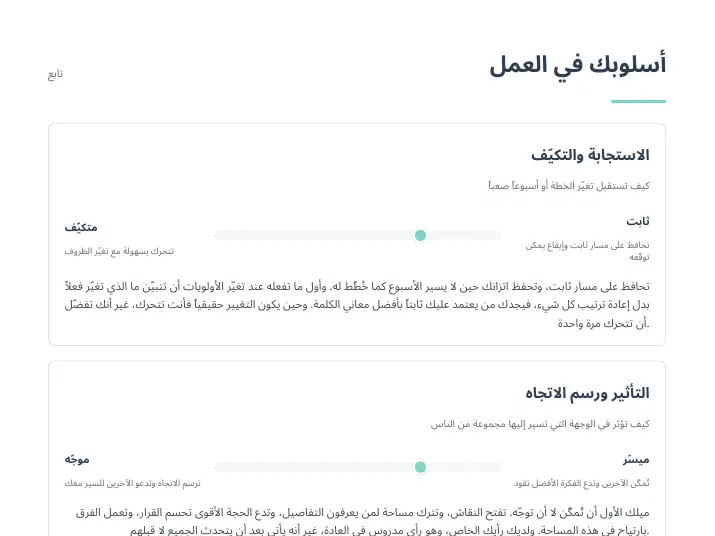
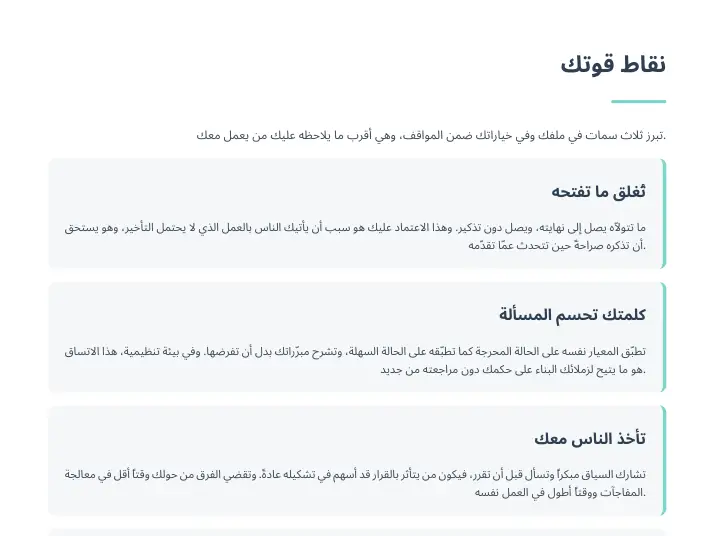
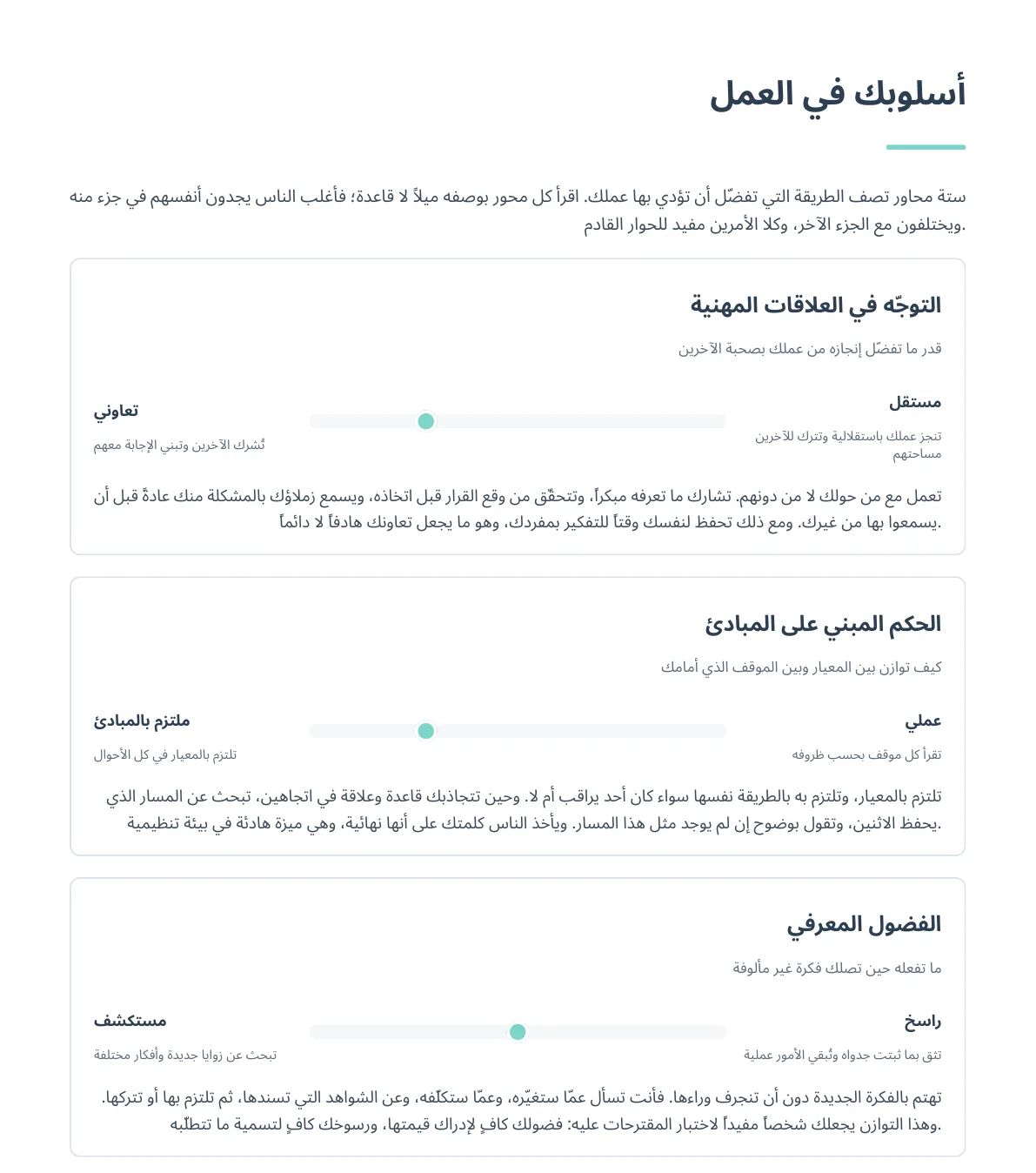
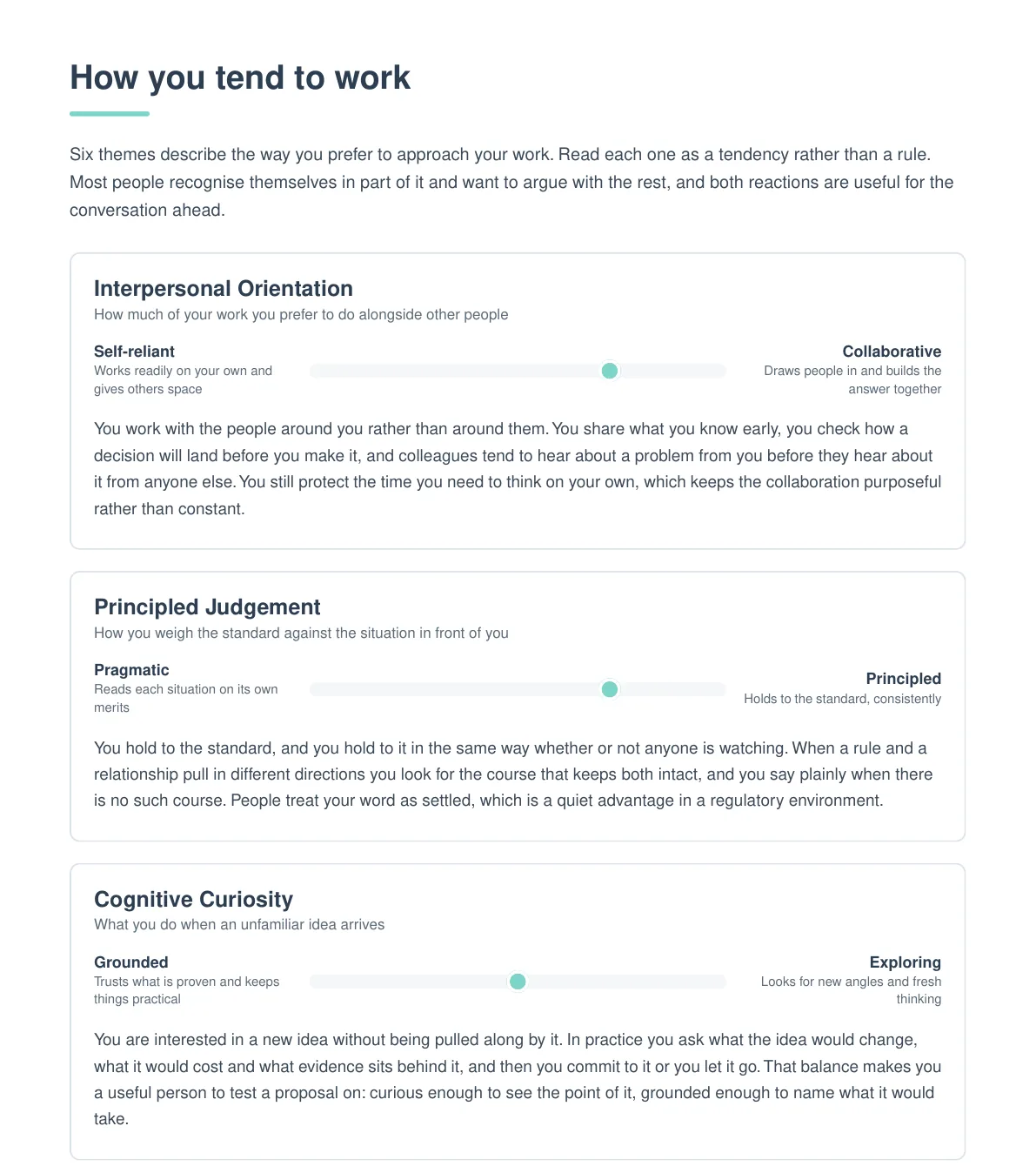
Same scores. Four programmes. Four different plans.
The profile below is the same for every track. Choose one of four programme levels to see how the plan changes.
Assessment profile
Identical across all four tracks
- CollaborationEffective
- Integrity and trustStrength
- InnovationDeveloping
- Problem solvingStrength
- CommunicationEffective
- AccountabilityStrength
- AgilityDeveloping
- LeadershipEffective
Development plan
Development focus
Agility
Ask for the tasks whose brief is still changing. Taking them on early, and staying calm while they settle, is how adaptability shows at this level.
Mapped to
Working Through Change: what to do when the brief changes mid-task.
Where to start
- Take the next task whose brief is least settled, and write down what you expect to change before you begin.
- When your work is re-prioritised, ask what stays fixed before you ask what moves.
Also in this plan: Innovation, Leadership
Illustrative output. Real plans are reviewed and released by qualified assessors before a participant sees them.
What changes for your client
Instead of: A generic personality report
With Masaar: A development plan mapped to the modules each participant is about to take
Instead of: Arabic translated at the end
With Masaar: Arabic written from the start, to the same standard as the English
Instead of: An end-of-course satisfaction survey
With Masaar: The same competencies measured twice, against one standard
Show your client what changed.
Assess participants at the start and the end of the programme against the same competency framework. The two results are stored separately, so change is reported against one standard rather than as two unrelated snapshots.
Cohort average on a 1 to 5 scale
- Collaboration3.2 → 3.6
- Innovation2.6 → 3.3
- Communication3.4 → 3.7
- Agility2.7 → 3.4
- Leadership3.0 → 3.5
- Accountability3.6 → 3.8
What each participant receives
A bilingual assessment report and an individual development plan. The plan is written from the participant's own scores and mapped to the programme they are joining. Where the programme calls for it, a qualified assessor reviews it before release.
Try three items from our personality instrument
Three items from our sample personality instrument. Scored in your browser. Nothing is stored.
I enjoy being the center of attention in group settings and feel energized by social interactions.
I go out of my way to help colleagues succeed, even when it requires extra effort on my part.
I prefer to plan my work carefully and create detailed schedules before starting any project.
Answer all three statements to see your profile.
Answer all three statements to see your profile.
Method
The instruments and how we use them
Each battery is built from the client's own competency framework. Every competency is mapped to dimensions an instrument can measure, and that mapping is written up for your proposal.
| Instrument | Measures | Languages |
|---|---|---|
| Hogan HPI, HDS, MVPI | Personality, derailment risk, values | Arabic, English |
| Matrigma | Non-verbal reasoning | Language-neutral |
| EQ-i 2.0 | Emotional intelligence | Arabic, English |
| Masaar item bank | Personality items and situational judgement tests written for the region | Arabic, English |
- Measured twice
- Participants can be assessed at the start and end of a programme against the same framework. The two results are stored separately, so change is reported against one standard.
- Norms
- We use publisher norms where they apply. Regional norms are built from our own Gulf dataset as it grows.
- Review
- Occupational psychologists design each battery and, where the programme calls for it, review reports before release. Scoring rules are versioned, and every score traces back to the responses behind it.
For training providers
How it works for a training provider
You pay per participant. There is no platform or licence fee. Reports and the participant portal carry your logo, and Masaar is credited as the platform.
We do not contact your clients directly.
You
- Win and contract the client
- Design and deliver the programme
- Own the client relationship
qpeople
- Build the battery from the client's framework
- Run delivery and participant support in Arabic and English
- Score, report and write each development plan
- Psychologist review before release, where the programme calls for it
From first call to released plans
- 1
Scoping call
The client's framework, cohort size and languages.
- 2
Battery and rates
A documented battery and an indicative rate for your proposal.
- 3
Delivery
Participants complete it online. You see completion as it happens.
- 4
Reports and plans
Released after review, before the programme starts.
For the proposal
Lines you can use in a bid as written. Each one describes what Masaar does today.
Assessment is configured against the client's existing competency framework rather than a vendor model.
Each competency is mapped to validated dimensions, with a documented rationale for every instrument used.
Delivery in Arabic and English, using established publisher instruments or a regionalised alternative.
Results are reported against the client's own competency framework, individually and at cohort level, with traceable scoring.
Each participant receives an individual development plan mapped to their own results and to the programme content.
Re-measurement against the same competency framework at programme end, reported as change from baseline.
5,000+
candidates assessed across the United Arab Emirates, Saudi Arabia, Oman and the United Kingdom.
Send us your learning outcomes.
We'll send back a draft battery map within two working days: each outcome mapped to the instruments that can measure it.